Engineering
How was the Brooklyn Bridge built?
Builders sank two huge timber chambers called caissons into the East River, dug beneath them in compressed air, and raised stone towers on top. They built massive anchorages on each shore, spun four steel wire cables between them, then hung the deck from those cables. The work took 14 years, and the bridge opened in 1883.
By BookPounce | Updated
Who designed and built the Brooklyn Bridge?
John A. Roebling designed the bridge. He was a German-born engineer who had patented a form of wire rope in 1842 and completed a major suspension bridge at Cincinnati in 1866 [2]. His plan for the East River combined hanging cables, diagonal stays and stiffening trusses [4].
He never saw it built. Roebling was injured on June 28, 1869, while the project was still getting started, and died of tetanus on July 22. His son, Washington Roebling, was appointed chief engineer that August at age 32 [2].
Washington had studied caissons in Europe before the work began [5]. In 1872 he suffered a severe attack of caisson disease, now called decompression sickness. It partly paralyzed him and damaged his sight and hearing, but his mind stayed sharp [5].
His wife, Emily Warren Roebling, became his link to the project. She wrote his letters, kept his notebooks, reviewed plans, visited the site and met with contractors and officials [5]. The bridge is the work of all three Roeblings, along with assistant engineers, contractors and a large labor force that did the dangerous physical work.
How did workers build foundations under the East River?
They used pneumatic caissons. Picture a giant wooden box with a thick roof and no floor. Crews floated it into place and loaded masonry on top, so it settled onto the riverbed. Compressed air pumped into the chamber below pushed the water out [4]. Workers entered through airlocks and dug away mud and boulders. As they dug, the box and the growing tower above it sank lower [3][4].
The caissons were enormous. The Brooklyn one measured 168 by 102 feet, and the New York one 172 by 102 feet [3]. The Brooklyn caisson reached firm rock 44.5 feet below the river surface in March 1871. It also survived a fire in its timber roof [3].
The New York side was harder. Borings showed rock far deeper, at about 106 feet. The caisson stopped at 78 feet 6 inches in May 1872, resting on dense sand and gravel [3]. Crews then filled the working chamber with concrete [3].
That decision limited the time people had to spend under high pressure. The tower on the New York side still stands on that compacted material, not directly on bedrock.
Why were the caissons so dangerous?
The same compressed air that kept the river out could injure the people breathing it. Under pressure, extra gas dissolves into your blood and tissues. If you return to normal pressure too quickly, that gas forms bubbles. Workers called the result the bends or caisson disease [4].
Symptoms included joint pain, numbness, paralysis and convulsions, and some cases were fatal [4]. More than 100 workers suffered from it [4]. The engineers shortened shifts under pressure to four hours as the New York caisson went deeper [3]. The value of slow, gradual decompression was understood only later [4].
There were other hazards too. Men dug by hand and used explosives inside the chambers [4]. Fire was a threat in a timber box filled with compressed air. Above the water, crews worked at great height on stone towers and narrow catwalks [1].
Accounts of the total death toll differ, partly depending on what is counted. At least 20 people died during construction [4]. When you walk across today, the foundations that cost the most in health and safety are the part you cannot see.
How were the towers, anchorages and cables made?
The towers rose from the caissons, with limestone below the water and granite above [2]. They took years to finish and were complete by 1876 [2]. The American Society of Civil Engineers (ASCE) gives their height as 276.5 feet [1].
On each shore, crews built a masonry anchorage weighing about 60,000 tons. Inside, chains of iron or steel links hold the ends of the cables. The Brooklyn anchorage was finished in 1875 and the New York one in 1876 [3].
Next came the cables. A cable this large is too heavy to make on the ground and lift. Instead, it was spun in place. A traveling wheel carried wire back and forth across the river, from anchorage to anchorage. The wires were grouped into strands, and each of the four main cables has 19 strands [3][4]. The strands were then compacted and wrapped into one round cable, nearly 16 inches across, holding more than 5,000 galvanized steel wires [1].
Spinning the main cables ran from June 1877 to October 1878 [3]. This was a pioneering use of galvanized steel wire in bridge cables [1].
What was the Brooklyn Bridge wire fraud?
The cable wire had to meet strict strength tests. In late 1876 the bridge's board awarded the wire contract to a supplier named J. Lloyd Haigh [3].
Haigh cheated the inspection process. Wire that had passed testing was swapped for rejected wire on the way to the bridge [3]. Roebling's team had discovered the fraud by June 1878. By then, bad wire was already inside the cables, and it could not practically be pulled out. Roebling estimated that as much as 221 tons of rejected wire might have been spun in [3].
The fix was to add strength. Haigh had to supply 150 extra wires for each cable at no charge [3]. Roebling estimated that the finished cables still had a safety factor of about five [3]. In plain words, they could carry about five times the load they were expected to bear.
This is a useful engineering lesson. A generous safety margin protects against more than storms and heavy traffic. It can also cover flaws in materials and human failures that the designer did not plan for. Testing matters, and so does tracking what happens to material after the test.
How does the deck hang, and when did the bridge open?
A suspension bridge passes its load along a clear path. The deck hangs from vertical wire ropes called suspenders. The suspenders pull on the main cables. The cables carry that tension over the towers and into the anchorages. The towers are mostly squeezed downward, which stone handles well.
For an evenly loaded cable, a handy formula is H = wL^2 / (8d). H is the horizontal pull, w is the load per unit length, L is the span and d is the sag. A flatter cable has a smaller sag, so it must pull harder.
Roebling added two more defenses against movement: stiffening trusses along the deck and diagonal stays running from the towers [1][3]. The stays cross the suspenders and create the web pattern you see in photographs [3]. Crews began installing the floor framing in 1880, using steel [3].
The bridge opened on May 24, 1883 [1]. Its main span of 1,595.5 feet set a world record [1]. The project had been expected to take about five years and cost $7 million. It took 14 years and cost about $15.5 million [3].
Books to read
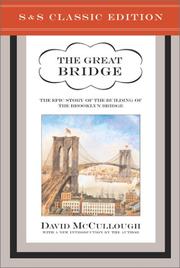
The Great Bridge
This is the big narrative account of the bridge, from John Roebling's plan to opening day. You get the caissons, the politics, the illness and the people in one long, readable story. It suits you if you want the full picture and do not mind a thick book with plenty of detail.

The Brooklyn Bridge
A short, illustrated history written for young readers. It is a good place to start if you want to picture how caissons, towers and cables fit together before reading anything longer. It also works well for a parent or teacher explaining the bridge to a curious child.

The Engineer's Wife
A historical novel built around Emily Warren Roebling and her part in finishing the bridge. Read it for the human side of the story and the pressure on one family. Because it is fiction, check scenes and dialogue against a history before treating them as fact.

Chief Engineer
A biography of Washington Roebling, the person who directed construction through years of serious illness. It helps you understand Washington's training, Civil War service, family life and relationship with a demanding father. Choose it if you care as much about the engineer as about the structure.
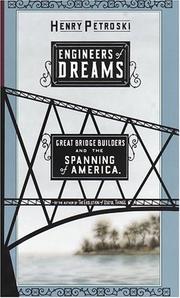
Engineers of Dreams
A history of American bridge building told through major engineers and their projects. It places large spans in a wider story of ambition, rivalry, design choices and failure. It suits you if the Brooklyn Bridge has made you curious about what bridge engineers did next.

Engineering America
A detailed life of John A. Roebling, who designed the bridge but did not live to build it. You learn about the immigrant, manufacturer and thinker behind the plan. It is best for readers who want serious biography and the background to Roebling's ideas.

Brooklyn Bridge
A cultural history that asks what the bridge came to mean to Americans, in addition to how it came to exist. Expect discussion of ideas, art and literature more than construction methods. It suits students and readers who enjoy looking at engineering through history and culture.
Questions readers ask
How long did it take to build the Brooklyn Bridge?
It took about 14 years, from the start of the project in 1869 to the opening in 1883. The original expectation was about five years. Deep foundations, illness, accidents, a caisson fire and problems with cable wire all made the work harder. The final cost was also more than double the early estimate of $7 million [3].
How did they build the Brooklyn Bridge towers underwater?
Workers did not lay stone in open water. They sank huge bottomless timber boxes called caissons and pumped in compressed air to keep water out. Crews dug inside while masonry piled up on the roof, pushing each box down. Once it reached a firm enough base, they filled the chamber with concrete [3][4].
Did Emily Roebling build the Brooklyn Bridge?
She played a central role, though she did not build it alone. After Washington Roebling became ill in 1872, Emily wrote letters, kept notes, reviewed plans, visited the site and dealt with officials and contractors. Washington remained chief engineer. Assistant engineers and many workers carried out the construction. Emily drove the first carriage across before the public opening [5].
How many people died building the Brooklyn Bridge?
There is no single figure that every account uses. History.com reports that at least two dozen people died during construction [4]. Causes included accidents and caisson disease, and designer John A. Roebling died from tetanus after an injury early in the project [2]. Many more workers were injured or became ill.
Is the Brooklyn Bridge a suspension bridge or a cable-stayed bridge?
It is mainly a suspension bridge: four large cables run over the towers into anchorages, and vertical suspenders hold the deck. It also has diagonal stays running from the towers to the deck, which add support and stiffness. That mix gives the bridge its familiar web pattern and is why people sometimes call it a hybrid [3][4].
Sources
- Brooklyn Bridge (Historic Civil Engineering Landmark). American Society of Civil Engineers. Accessed 2026-11-28.
- New York's Brooklyn Bridge is an engineering marvel. Civil Engineering Magazine, ASCE. Accessed 2026-11-28.
- Brooklyn Bridge, Part 2. STRUCTURE magazine. Accessed 2026-11-28.
- Brooklyn Bridge. HISTORY. Accessed 2026-11-28.
- Emily Roebling and the Brooklyn Bridge. HISTORY. Accessed 2026-11-28.