Company stories
The history of Coca-Cola
Coca-Cola began in Atlanta in 1886, when pharmacist John Pemberton created a syrup sold at a soda fountain. Asa Candler gained control and built the brand. Franchised bottlers spread it across America, Robert Woodruff's era took it abroad, and later decades brought Diet Coke, New Coke and a business in more than 200 countries.
By BookPounce | Updated
Who invented Coca-Cola?
John Stith Pemberton, a pharmacist in Atlanta, made the first Coca-Cola syrup. On May 8, 1886, the syrup went to Jacobs' Pharmacy, where it was sold as a soda fountain drink for five cents a glass [1]. Pemberton had earlier marketed a health drink called French Wine Coca [4].
The name came from his circle. Frank M. Robinson, Pemberton's partner and bookkeeper, suggested "Coca-Cola" and wrote it in the flowing script that became the trademark. He thought the two capital Cs would look good in advertising [1]. The original drink contained cocaine. The formula was changed before the Pure Food and Drug Act of 1906 [4].
The start was small. In its first year, sales averaged about nine drinks a day [1]. Pemberton did not stay long enough to see what followed. He sold parts of the business to several partners, sold his remaining interest, and died in 1888 [1]. The next chapter belongs to a businessman who saw far more in the syrup than a local refreshment.
How did Asa Candler turn a syrup into a business?
Asa G. Candler, an Atlanta businessman in the drug trade, bought Pemberton's remaining interest in 1888 and then acquired further rights [1]. Control took some time to settle. Candler advertised himself as sole proprietor in 1889, but achieved actual sole ownership in 1891 [2].
In 1892 he formed The Coca-Cola Company as a Georgia corporation with 100,000 dollars of initial capital. He also sold his pharmaceutical business so he could focus on the drink. The Coca-Cola trademark was registered on January 31, 1893 [2].
Candler believed in advertising. He handed out thousands of coupons for a free glass, which gave people a reason to try something new [2]. He also pushed production beyond Atlanta. A syrup plant opened in Dallas in 1894, followed by plants in Chicago and Los Angeles in 1895. That year, Candler reported that Coca-Cola was sold in every U.S. state and territory [2].
The lesson is simple. A good product mattered, but sampling, branding and wider supply turned it into a national business.
Why were bottlers so important to Coca-Cola?
At first, you mostly drank Coca-Cola at a soda fountain. Bottles let people take it elsewhere. Joseph Biedenharn of Vicksburg had obtained bottling rights for Mississippi in 1894. In 1899, two Chattanooga lawyers, Benjamin Thomas and Joseph Whitehead, obtained rights to bottle the drink across the rest of the country [4].
This created a franchise system. The company supplied the syrup and the brand, while bottlers served their own territories. Between 1899 and the 1920s, the number of bottling plants grew from two to more than 1,000, and 95 percent were locally owned and operated [2].
Success attracted imitators. In 1915, the bottlers' association voted to spend up to 500 dollars on a distinctive bottle. The Root Glass Company of Terre Haute, Indiana, produced the winning design, with a shape inspired by an illustration of a cocoa bean. A patent followed in November 1915 [3]. By 1920, most bottlers were using it [3]. The shape was later granted trademark status in 1961 [3]. Today it is often called the contour bottle.
What changed under Robert Woodruff and during World War II?
In 1919, the Candler interests sold the company for 25 million dollars to a group led by Ernest Woodruff. His son, Robert Woodruff, became president in 1923 [4]. The company began building its global network in the 1920s [9], and it formed the Coca-Cola Export Corporation in 1930 [4].
Advertising shaped the brand too. In 1931, the company commissioned artist Haddon Sundblom to paint Santa Claus. His warm, cheerful Santa appeared in Coke advertising until 1964 [8].
By the outbreak of World War II, Coca-Cola was bottled in 44 countries [5]. After the United States entered the war, Woodruff ordered that every person in uniform should be able to get a bottle for five cents. In 1943, General Dwight Eisenhower's headquarters in North Africa requested equipment for bottling plants. Over the course of the war, 64 plants were shipped abroad, and military personnel drank more than 5 billion bottles [5].
The wartime network left a wider footprint. From the mid-1940s to 1960, the number of countries with bottling operations nearly doubled [5].
What happened with Diet Coke and New Coke?
The 1980s brought two very different launches. In 1982, the company introduced Diet Coke, starting in a handful of U.S. markets. It was a bold step because it put the famous Coke name on a new drink. By the end of 1983, it was the leading diet soft drink in the United States [7].
On April 23, 1985, the company announced a new formula for its flagship drink, the first change in 99 years. Its share lead over its chief competitor had been slipping for 15 years, and taste tests with nearly 200,000 consumers had favored the new recipe [6].
Many loyal drinkers were upset. By June, the consumer hotline was receiving about 1,500 calls a day, compared with 400 before the change. On July 11, 1985, 79 days after the announcement, the company said the original formula would return as Coca-Cola Classic [6].
The episode is still studied because it shows that people can value a brand for memory and identity, not only for taste.
Where does Coca-Cola stand today, and what can you learn from it?
Coca-Cola is now much more than one drink. The company says its system operates in more than 200 countries and produces nearly 450 brands [9]. The word "system" matters here. It covers the company together with its bottling partners, a structure whose roots go back to the 1899 bottling agreement.
If you read the story as a business case, a few threads stand out. The company protected its name and its bottle shape. It spent steadily on advertising, from free-glass coupons to holiday art. It relied on partners to put the drink within reach. It also learned, very publicly in 1985, that customers can feel they own a product as much as its maker does.
Official company histories are useful for dates and milestones, but they tell the story from inside. For a fuller picture, pair them with independent journalists and historians. The books below include broad histories, insider memoirs and critical studies of labor, resources and global power, so you can compare viewpoints and judge for yourself.
Books to read
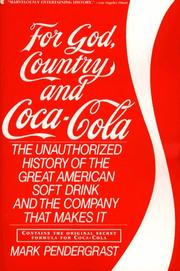
For God, country and Coca-Cola
A broad, detailed history that follows the drink from Pemberton's Atlanta to a worldwide business. Pick this if you want one large book that covers the founders, the advertising, the rivalries and the controversies. It suits readers who enjoy depth and a strong narrative.
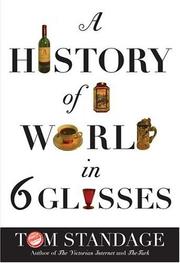
A history of the world in 6 glasses
Standage tells world history through six drinks, and Coca-Cola is one of them. It is an easy starting point if you want to see why a soft drink matters beyond business, especially in the story of American influence. It suits curious general readers.
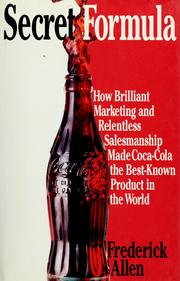
Secret formula
A journalist's account of the people who ran Coca-Cola and the decisions that shaped it. Read it if leadership, marketing and boardroom choices interest you more than product trivia. It works well alongside Pendergrast, giving you a second view of many of the same turning points.
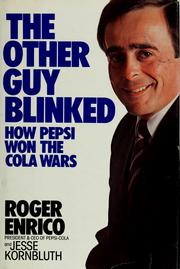
The other guy blinked
Written by a Pepsi executive with Jesse Kornbluth, this gives you the cola wars from the rival's side. Expect a partisan, lively insider view, not a neutral history. It suits readers who want to understand how competition looked while New Coke was unfolding.

Inside Coca-Cola
A former Coca-Cola chairman and chief executive, writing with David Beasley, recalls a long career in the business. It suits readers interested in international management and leading a large company through difficult periods. Read it as a personal account from someone with a stake in the story.

Citizen Coke
A historian examines where Coca-Cola's ingredients and resources came from, and who carried the costs of supplying them. Choose it if you care about water, sugar, supply chains and environmental history. It offers a critical angle that official company accounts are unlikely to emphasise.
Counter-Cola
A scholarly study of Coca-Cola as a global corporation and of the movements that have challenged it in different countries. It suits students and advanced readers interested in labor, politics and globalisation. Expect close argument and a critical lens, not a light brand story.
Questions readers ask
When was Coca-Cola invented?
Coca-Cola dates to 1886 in Atlanta, Georgia. Pharmacist John Stith Pemberton made the syrup, and on May 8 of that year it was sold as a soda fountain drink at Jacobs' Pharmacy for five cents a glass. His partner Frank Robinson suggested the name and wrote the script lettering.
Did Coca-Cola ever contain cocaine?
Yes. The Georgia Encyclopedia states that the original drink contained cocaine, and that the formula was changed before the Pure Food and Drug Act of 1906. This belongs to the drink's early history in the late nineteenth and early twentieth centuries, not to the product sold today.
Who made Coca-Cola a big company?
Several people did. Asa Candler formed the company in 1892 and promoted the drink widely. Bottlers carried it into towns across the United States from 1899. After a group led by Ernest Woodruff bought the firm in 1919, Robert Woodruff became president in 1923 and led its later expansion.
Why did New Coke fail?
New Coke met a strong public backlash even though taste tests had favored the new recipe. Many loyal drinkers objected to losing the original, and calls to the company's hotline rose sharply. The company announced the return of the old formula, as Coca-Cola Classic, on July 11, 1985.
Did Coca-Cola invent Santa Claus?
No. Santa Claus existed long before the company's advertisements. What Coca-Cola did was commission artist Haddon Sundblom, starting in 1931, to paint a warm and cheerful Santa for its holiday campaigns. Those images ran for decades and strongly influenced how many people picture him.
Sources
- The Birth of a Refreshing Idea. The Coca-Cola Company. Accessed 2026-11-29.
- The Asa Candler Era. The Coca-Cola Company. Accessed 2026-11-29.
- The History of the Coca-Cola Contour Bottle. The Coca-Cola Company. Accessed 2026-11-29.
- Coca-Cola Company. New Georgia Encyclopedia. Accessed 2026-11-29.
- The Chronicle of Coca-Cola: A Symbol of Friendship. The Coca-Cola Company. Accessed 2026-11-29.
- New Coke: The Most Memorable Marketing Blunder Ever. The Coca-Cola Company. Accessed 2026-11-29.
- The Extraordinary Story of How Diet Coke Came to Be. The Coca-Cola Company. Accessed 2026-11-29.
- Haddon Sundblom and the Coca-Cola Santas. The Coca-Cola Company. Accessed 2026-11-29.
- The Chronicle of Coca-Cola as a Global Business. The Coca-Cola Company. Accessed 2026-11-29.