Engineering
How the steam engine changed the world
The steam engine turned heat from fuel into mechanical work. It first drained mines, then drove factory machines, trains and ships. This loosened industry's dependence on muscle, wind and water, shortened journeys and led to modern power stations. The change was slow: its biggest boost to British economic growth came about a century after James Watt's breakthrough.
By BookPounce | Updated
How does a steam engine turn heat into work?
A steam engine burns fuel to boil water. The steam then pushes, or helps to push, a piston or a turbine. That movement can drive a pump, a wheel or a generator.
Early engines worked in a way that may surprise you. In Thomas Newcomen's design, steam filled a cylinder under a piston. Cooling the steam made it condense, which left a partial vacuum. The air outside then pushed the piston down. This is why it is called an atmospheric engine. A heavy beam passed that motion to a pump.
The weakness was heat. In simple terms, the same cylinder had to be hot to hold steam and cold to condense it. Each stroke wasted fuel warming the metal again.
Later engines used steam at higher pressure to push the piston directly. A useful rule of thumb is:
work = pressure x piston area x stroke length
Here pressure means the average difference in pressure across the piston. Raise it and an engine of the same size can do more work. That made engines more practical for vehicles, where space and weight matter. It also asked much more of the boiler, which had to hold that pressure safely.
Who invented the steam engine, and what did James Watt change?
No single person invented it. Thomas Savery received a patent for a steam powered pumping device in 1698 [2]. Newcomen turned the idea into a practical industrial machine, first erected near Dudley Castle in England in 1712 [1]. Because Savery's patent was so broad, Newcomen had to work with him as a partner [2].
Newcomen's engine used a lot of fuel, but mine operators still valued it. It ran at low pressure, so it was much less likely to explode than Savery's design [2].
James Watt attacked the waste. He condensed the steam in a separate vessel, so the main cylinder could stay hot. His patent, granted on 5 January 1769, described a new method of lessening the use of steam and fuel. Engines with his condenser burned two thirds less coal [3].
That saving mattered far beyond the mine. A thriftier engine could make sense in mills, workshops and other places that needed power [3]. Watt then worked with the manufacturer Matthew Boulton on engines that produced rotary motion. Instead of only rocking a pump up and down, these could turn shafts and wheels. A surviving example from 1788 drove 43 metal polishing machines at Boulton's Soho works for about 70 years [4].
How did steam power change industry and the economy?
Before steam, work depended heavily on people, animals, wind and falling water. A waterwheel needs a suitable stream, and its power can change with the weather. An engine needs fuel and water, so owners gained more choice about where and when to work. Coal became more and more central to industry.
The Lap engine at Soho shows the idea in one room. One source of rotary power turned many machines [4]. The same principle could serve a larger factory through shafts and belts.
It is tempting to picture an overnight revolution. The economic evidence says otherwise. The historian Nicholas Crafts estimated that steam added little to British growth before 1830. Its peak effect arrived about a hundred years after Watt's famous invention, and its potential was realised only with high pressure steam after 1850 [8].
Why so slow? A powerful new technology rarely works alone. As a way to think about it, engines had to become cheaper to run, machines had to be built around them, and owners had to replace methods that still worked well enough. You can see a similar pattern in many engineering changes: the first working machine is the start of the work, not the end.
How did steam change travel and time?
Put an engine on wheels and the map starts to shrink. On 21 February 1804, Richard Trevithick's locomotive ran 9 miles from the Penydarren ironworks in Wales. It hauled ten tons of iron and about seventy riders, but it was heavy enough to break rails [5].
The Liverpool and Manchester Railway opened on 15 September 1830. Passengers took to it quickly: around 800 a day were travelling by October. It helped set the pattern for railway building elsewhere and changed how people thought about distance and time [6].
Water transport changed too. In 1807, Robert Fulton's steamboat travelled about 150 miles up the Hudson River from New York to Albany in 32 hours [11]. A boat with its own engine did not have to wait for a helpful wind.
Faster travel exposed an odd problem. Towns kept their own local time, based on the Sun. In November 1840, Britain's Great Western Railway told its stations to use London time. By 1855, almost all public authorities in Britain had adopted railway time [7]. A timetable works far better when everyone reads the same clock.
What were the costs of the steam age?
Steam brought new power, and much of that power came from burning coal. Engines were only one use of it. Furnaces, workshops and homes burned coal too, so you should not blame all the smoke on steam engines.
Still, the wider industrial system that steam helped to build had a heavy health cost. Economists Brian Beach and W. Walker Hanlon studied industrial coal use and deaths in Britain from 1851 to 1860. They found that a one standard deviation rise in coal use raised infant mortality by 6 to 8 percent. Industrial coal use explained about one third of the higher death rate seen in towns and cities during that period [9].
There were engineering risks as well. A boiler stores a great deal of energy. If its metal, valves or upkeep fail, that energy can escape violently. Higher pressure made engines more capable and made sound design more important.
The lesson is useful for any engineer. Judge a machine by what it produces, and also by what it uses, what it releases and who carries the risk. Gains and harms can arrive together, and they are not always shared equally.
Is steam power still used today?
Yes. The clanking piston engine has mostly given way to other machines, but steam still does major work inside turbines. A turbine lets flowing steam spin rows of blades. The spinning shaft can turn a generator and make electricity.
Charles Parsons built an experimental turbine generator in 1884. It ran at 18,000 revolutions per minute with little vibration, which suited electrical generation. The Science Museum Group calls it the forerunner of the turbo-generators that today provide most of the world's electricity. Turbines were later used to drive ships too [10].
The heat does not have to come from coal. Power stations can raise steam using gas, nuclear fission, biomass, geothermal heat or concentrated sunlight. The source changes, while the basic chain stays familiar: heat creates steam, steam turns a shaft, and the shaft drives a generator.
So when you switch on a light, you may be using a descendant of this idea. It depends on where your electricity comes from. Wind turbines, solar panels and most hydroelectric plants make power without boiling water. The steam age changed its shape more than it simply ended.
Books to read
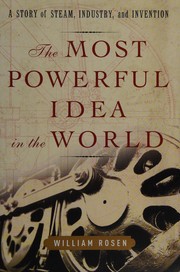
The most powerful idea in the world
Start here if you want a lively story with people at its centre. Rosen follows the road to steam power and asks why invention took off in Britain, bringing in science, craft skill and patent law. It suits general readers who like big questions along with their machines.

the lunar men
This group biography introduces Watt, Boulton and their circle of curious friends in the English Midlands. You see how engines grew within a world of conversation, experiment, business and friendship. Choose it if you enjoy biography and want the human setting around the technical breakthroughs.

Energy
Rhodes tells the story of how people moved between sources of energy, from wood and coal to oil, nuclear power and renewables. Steam has an important place in that longer account. It suits readers who want to connect old engines with today's choices about power.

The industrial revolution, 1760-1830
A short classic that places invention alongside capital, labour, trade and ideas. It gives you a compact frame for understanding why engines were only one part of industrial change. Remember its age as you read, since historians have revised and debated many points since it appeared.

The Railway Journey
Read this to learn how rail travel changed experience, not only transport. It explores how passengers came to see landscapes, space, time, comfort and danger in new ways. It is a good choice for readers interested in culture and psychology as much as engineering.

The British industrial revolution in global perspective
Allen asks why the Industrial Revolution happened in Britain first. The argument gives close attention to wages, energy prices and the incentives to adopt machines, including steam engines. Expect economic evidence and comparison between countries. It suits students and readers ready to test a clear, debated explanation.
Energy and the English Industrial Revolution
Wrigley explains the shift from an economy limited by what the land could grow each year to one drawing heavily on coal. This helps you see why steam mattered within a larger energy system. It is best for readers who want a focused economic history.
Questions readers ask
Did James Watt invent the steam engine?
No. Savery and Newcomen built steam powered machines before Watt's work. Watt made a major improvement by condensing steam in a separate vessel, which greatly reduced coal use. He later helped develop engines that produced rotary motion. His importance lies in making steam power more economical and useful for a wider range of jobs.
What was the steam engine first used for?
Its early job was raising water, especially to help keep mines from flooding. This was a practical problem: deeper mines collected water that had to be removed before work could continue. Newcomen's engine moved a pump with a rocking beam. Later designs turned wheels, which opened the way to driving machinery and vehicles.
Did the steam engine cause the Industrial Revolution?
Not by itself. Industrial change also involved new machines, labour, investment, trade, materials and energy supplies. Steam became one powerful part of that system, but its economic effect built slowly. Crafts estimated that it added little to British growth before 1830. It is better to call it a major driver than the single cause.
Why was the steam engine important for transport?
It gave trains and boats their own mechanical power. Railways could move people and heavy loads between places on regular services, while steamboats were less dependent on wind. Faster connections changed business and daily life. Railway timetables also encouraged towns to share a standard time instead of each following its own local clock.
Sources
- A new age. Science Museum Blog. Accessed 2026-11-29.
- Thomas Savery, Scientist of the Day. Linda Hall Library. Accessed 2026-11-29.
- James Watt and the separate condenser. Science Museum Blog. Accessed 2026-11-29.
- Rotative steam engine by Boulton and Watt, 1788. Science Museum Group. Accessed 2026-11-29.
- Richard Trevithick's steam locomotive. Museum Wales. Accessed 2026-11-29.
- The opening of the Liverpool and Manchester Railway. National Museums Liverpool. Accessed 2026-11-29.
- 180 years of railway time. Network Rail. Accessed 2026-11-29.
- Steam as a general purpose technology: a growth accounting perspective. The Economic Journal (abstract via RePEc). Accessed 2026-11-29.
- Coal smoke and mortality in an early industrial economy. The Economic Journal (abstract via RePEc). Accessed 2026-11-29.
- Parsons' steam turbine generator, 1884. Science Museum Group. Accessed 2026-11-29.
- Robert Fulton. Britannica. Accessed 2026-11-29.